
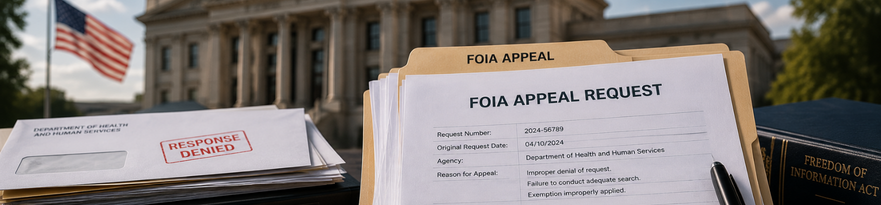
FOIA appeal
service.
FileFOIA is a professional FOIA appeal service that challenges denied, delayed, and over-redacted public records requests. A denial is not the end — it opens your right to appeal. Our FOIA appeal service analyzes every exemption the agency cited, drafts a targeted administrative appeal, and fights for your complete records. Flat fee. Done for you. No attorney required.
Most FOIA denials are legally
invalid. We prove it.
Government agencies deny FOIA requests for two reasons: they have a legitimate legal basis to withhold records, or they’re hoping you go away. FileFOIA exists because the second case is far more common than agencies would like to admit.
Under federal FOIA law, agencies bear the burden of proving their withholding is justified — not you. When you hire our FOIA appeal service, we flip that dynamic. We analyze the agency’s denial letter, identify every exemption they cited, and build a legal argument for why each one is invalid, overbroad, or misapplied.
FOIA appeals are administrative proceedings — not court cases. You don’t need a lawyer. You need a FOIA appeal service that knows the law and knows how agencies operate. That’s what we do.
Start Your FOIA Appeal — $149Agencies abuse these exemptions.
Our FOIA appeal service knows how to fight back.
Federal FOIA has nine statutory exemptions. Agencies cite them constantly — often beyond what the law actually permits. We analyze each exemption for legal validity and challenge every one that doesn’t hold up.
National Security
Classified information under Executive Orders. Difficult to challenge without security clearance. We request Vaughn indices to verify classification was properly applied.
Rarely challengedInternal Agency Rules
Purely internal personnel rules with no public interest. Narrowed significantly by the Supreme Court. We challenge any (b)(2) claim on records that affect the public.
Frequently challengedStatutory Exemptions
Records protected by other federal statutes — tax returns, grand jury materials, certain intelligence. Generally valid when properly cited. We verify the correct statute was applied.
Context-specificTrade Secrets
Confidential commercial information from third parties. Agencies frequently over-apply this to protect contractors. We challenge (b)(4) claims where commercial harm isn’t substantial or likely.
Frequently challengedDeliberative Process
Pre-decisional, deliberative agency communications. The most abused exemption in FOIA. Agencies cite it to hide embarrassing records, not just protect genuine deliberations. We challenge (b)(5) more than any other exemption.
Most commonly abused — challenge alwaysPersonal Privacy
Constitutes a clearly unwarranted invasion of personal privacy. Requires a balancing test — public interest vs. privacy. We regularly win (b)(6) challenges by demonstrating strong public interest in disclosure.
Frequently challengedLaw Enforcement
Six sub-exemptions protecting law enforcement records. Most cited by FBI, ICE, DEA, and police departments. We challenge (b)(7) claims where the law enforcement purpose is stale or the records are otherwise segregable.
Context-specific — often challengeableFinancial Institutions
Records from or about financial institution examinations. Narrow and specific. We verify the correct regulatory relationship before accepting any (b)(8) withholding.
Narrow — rarely encounteredGeological Data
Well data and geological information about oil and gas wells. Extremely narrow. FileFOIA rarely encounters a legitimate (b)(9) claim outside energy sector requests.
Narrow — rarely encounteredHow our FOIA appeal service
challenges a denial.
A federal FOIA appeal is filed with the same agency — specifically its appeals office or the agency head — within 90 days of the denial letter. State FOIA appeal deadlines and procedures vary by state law. FileFOIA knows the correct process for every jurisdiction we cover.
If the administrative appeal is also denied, the next step is either FOIA mediation through OGIS or filing suit in federal district court. FileFOIA is not a law firm and does not handle FOIA litigation — for that step, we refer you to a qualified FOIA attorney. FileFOIA covers the administrative appeal process.
Most FOIA appeals are won or lost at the administrative level — before any court gets involved. A well-drafted appeal letter that correctly identifies invalid exemptions and cites controlling case law is what our FOIA appeal service delivers.
Hire Our FOIA Appeal Service — $149The agency sends a denial letter citing specific FOIA exemptions, or produces records that are clearly incomplete. You have 90 days from that letter to file an administrative FOIA appeal.
We review every exemption cited, cross-reference it against the legal standard, and identify which ones are invalid, overbroad, or misapplied. We also check for segregability — whether non-exempt portions were improperly withheld with exempt ones.
We draft a precise administrative appeal letter citing the specific legal errors in the agency’s denial, relevant case law, and a clear demand for production. No boilerplate — every appeal is tailored to the specific denial.
We submit the appeal to the correct agency appeals office before the deadline, timestamp the filing, and track the agency’s response. Agencies have 20 business days to respond to a FOIA appeal — we follow up when they miss it.
If the appeal is granted, additional records are released. If denied, our FOIA appeal service identifies whether OGIS mediation or federal litigation is the appropriate next step and refers you to a qualified FOIA attorney if litigation is warranted.
Four steps to challenging
your denied FOIA request.
Send us your denial letter
Upload your agency’s denial letter — or your original request and the agency’s response — through our intake form. Our FOIA appeal service needs the denial letter, the original request, and any records that were produced to build the strongest appeal.
We analyze and identify the weaknesses
We identify every exemption that doesn’t legally hold up, every production gap, every segregability failure, and every procedural error in the agency’s denial. This is where most FOIA appeals are won — before a single word is written.
We draft and file your appeal
A targeted appeal letter citing controlling case law, specific exemption challenges, and a demand for complete production. We file the appeal with the correct agency office before your 90-day deadline — never at the last minute.
We track and deliver the outcome
We monitor the agency’s response, follow up when they miss the 20-day response deadline, and deliver any newly released records to your secure client portal. If the appeal is denied, we advise on next steps including OGIS mediation.
Anyone whose FOIA request
was denied deserves a fight.
Individuals & Families
Got a denial on your own immigration records, VA file, or police records? Hire our FOIA appeal service to challenge it. Most individual denials are over-broad and winnable on appeal. Our done-for-you public records retrieval service handles the entire appeal for a flat $149 fee — no legal background required.
Journalists & Investigators
A denial is often a signal that records are worth fighting for. FileFOIA was built for exactly this situation — we file privately, challenge aggressively, and don’t publish anything about your investigation. See our journalist service for coordinated filing and appeal support.
Attorneys & Law Firms
Use our FOIA appeal service to challenge denials on pre-litigation discovery requests without tying up attorney hours on administrative filings. We handle the appeal process; you focus on the legal strategy. Retainer accounts available for high-volume practices.
FOIA appeal service —
your questions answered.
No. FOIA appeals are administrative proceedings — not court cases. Any person can file a FOIA appeal without legal representation. FileFOIA handles the entire process for a flat $149 fee. If your appeal is denied and you want to pursue federal court litigation, that step requires an attorney — and we refer you to qualified FOIA litigators when that’s appropriate.
Under federal FOIA, you generally have 90 days from the date of the agency’s denial letter. State FOIA appeal deadlines vary — some states give as few as 30 days. We track your deadline from the moment you hire us and files well before the cutoff. If you’re not sure how much time you have, book a consultation immediately.
A non-response is considered a constructive denial under federal FOIA — meaning you can treat it as a denial and appeal immediately. We file a constructive denial appeal citing the agency’s failure to respond within the statutory 20-business-day deadline. This is one of the most effective uses of a FOIA appeal service because agencies rarely have a legal defense for simply ignoring a request.
If the administrative appeal is denied, you have two options: FOIA mediation through the Office of Government Information Services (OGIS), or filing a lawsuit in federal district court. FileFOIA covers the administrative appeal. For OGIS mediation assistance or federal litigation, we refer you to qualified FOIA attorneys.
A Vaughn index is a document-by-document listing of withheld records and the specific exemption justifying each withholding. Agencies are required to provide one when challenged. We request a Vaughn index in every appeal involving significant withholding — it forces the agency to justify each redaction individually and frequently exposes over-withholding.
Yes. Every state open records law has its own appeal process — administrative appeals to the agency, appeals to a state oversight body, or direct court challenge depending on the state. FileFOIA handles state records appeals under all 50 state laws. See our state records service for state-specific information.
FileFOIA services that work
alongside our appeal service.
A denial is not
the end.
Hire our FOIA appeal service today — a done-for-you public records appeal that challenges invalid exemptions and fights for your complete records. Flat $149 fee.