
How to file a
FOIA request.
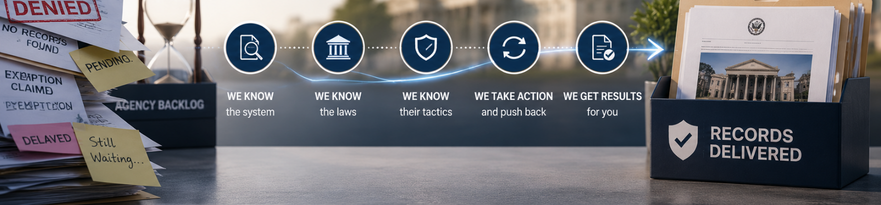
Agencies count on the fact that most people don’t know the system. FileFOIA does. We know exactly how to file a FOIA request — and more importantly, we know how government agencies delay, obstruct, and under-produce records when you file a FOIA request. This is how we fight for yours — and why knowing how to file a FOIA request is only the beginning. When you need someone to file a FOIA request the right way — someone who knows how to file a FOIA request and what to do when agencies push back — that is FileFOIA. That’s what FileFOIA is for — a done-for-you public records retrieval service that handles every step from intake to delivery. Here is exactly how our process works, what we do at each stage, and what you receive at the end.
How to file a FOIA request
through FileFOIA — four steps.
Tell us what you need — we know where it lives
Fill out our intake form. Most people don’t know which agency holds their records, which specific office within that agency accepts requests, or how to describe what they need precisely enough to get it. We do. Our team identifies the exact custodian, drafts a precise request, and knows which record types agencies routinely try to exclude from productions. You don’t need to know which specific office handles your records — that’s our job. That’s our job. We identify whether your records are at a federal agency, state agency, county government, or city department — and which specific office within that agency is the correct records custodian.
The more detail you can provide, the better. Being specific means better results — vague requests get denied or produce over-broad responses. Vague requests get denied or receive over-broad responses. Precise requests — naming specific record types, referencing specific dates, and citing relevant case numbers or names — get better results. We draft every request to maximize what you receive. If we need clarification before filing, we reach out before submitting anything.
Not sure which agency to file a FOIA request with, or whether FOIA is even the right approach? That’s what our $75 consultation is for — 30 minutes to map out exactly what records exist, where they live, and how to request them effectively.
How to file a FOIA request with the right agency — the first time
This is where most people go wrong when they try to do this themselves. Every federal agency has its own portal, its own procedures, and its own interpretation of what they must produce when you file a FOIA request — some use FOIAonline, others have proprietary systems, some still require mail. Every state has its own open records law with its own procedures and deadlines. Filing with the wrong office causes weeks of unnecessary delay. Filing with the right office but using the wrong format gets your request rejected.
FileFOIA files correctly the first time — every federal, state, county, and city agency, every time. We know the correct FOIA officer or records custodian, and the precise legal language that gets results. Knowing how to file a FOIA request correctly the first time is what separates FileFOIA from a simple filing tool. We timestamp every filing and begin tracking the statutory response deadline immediately upon submission.
For cases where you need to file a FOIA request with multiple agencies simultaneously — like a multi-agency FOIA request — like our immigration FOIA request covering USCIS, ICE, and CBP simultaneously — we coordinate all filings under one intake and track each one separately. You receive updates on all of them in one place.
How to file a FOIA request follow-up when agencies stall
Filing correctly is one thing — following up aggressively when agencies ignore it is another. When you file a FOIA request, agencies have a playbook. Knowing how to file a FOIA request is only part of it — knowing how to fight back is the rest. for avoiding compliance — ignore the deadline, cite a vague exemption, produce incomplete records and hope the requester gives up. Under federal FOIA law, agencies must respond within 20 business days. Most don’t. DHS, DOJ, and USCIS are chronically backlogged — responses routinely take months to over a year. State agencies generally respond faster, but many miss their statutory deadlines as well, especially for law enforcement records or politically sensitive materials.
FileFOIA doesn’t accept agency delays. We know how agencies think, which exemptions they over-apply, and exactly how to challenge them. Filing correctly is only half the battle — knowing how to fight for your records is the other half. We send follow-up letters when agencies miss the deadline. Knowing how to file a FOIA request appeal is critical — we do it automatically., request status updates, and escalate to administrative remedies when delays become unreasonable. If a request has been constructively denied through non-response, we notify you of your right to treat it as a denial and file an administrative appeal immediately.
You receive plain-English email updates at every stage — from the moment we file a FOIA request to the moment records are delivered — when we file, when the agency acknowledges the request, when records are produced, and when we identify any issues that require action. You never have to wonder where your case stands.
Your FOIA request results — delivered and gap analyzed
When records arrive from your FOIA request, most services consider the job done. We don’t. We know what a complete production looks like — and we know the tricks agencies use to make an incomplete production look complete. FileFOIA doesn’t. Every production from a FOIA request gets a document gap analysis — a systematic review of what the agency produced against what you originally requested. This is the step that separates a real public records retrieval service from a simple filing tool.
We check date ranges, look for missing attachments, verify that sent emails aren’t being withheld while received emails were produced, review redacted sections for invalid exemption citations, and flag any gaps in the production. If we find problems — and we frequently do — we draft follow-up letters, challenge improper exemptions, and prepare for an appeal if necessary.
All records from your FOIA request are organized, labeled, and delivered to your secure client portal and private Dropbox folder. Your full case history is there for every follow-up. You receive a complete case summary showing what was requested, what was produced, what was challenged, and what is still outstanding. Your full case history is in your portal — every letter we sent, every response we received, every production we analyzed.
What we check after every FOIA request
— knowing how to file a FOIA request follow-up is key.
Agencies produce what they want to produce from your FOIA request. Knowing how to file a FOIA request is step one — knowing how to verify the response is complete is step two. A gap analysis is how we find what they hoped you wouldn’t notice. Every FOIA request case includes a full gap analysis on every production — checking the items below before we consider a case complete.
If any of these checks fail, we draft a follow-up or appeal immediately. This is included in our Full Service tier and in every immigration records, veterans records, and police records case by default.
What happens when gaps are found
We draft a targeted letter identifying the specific gap, requesting the missing records, and citing the agency’s obligation to produce them. Most agencies respond to a well-drafted follow-up within days.
When an agency cites a FOIA exemption to withhold records, we analyze whether it’s legally valid. The (b)(5) deliberative process exemption is the most abused — we challenge it routinely.
When follow-up fails, we escalate to a formal administrative appeal challenging the agency’s production. See our FOIA appeal service for detail on how appeals work and what they cost.
If the appeal is denied, we refer you to the Office of Government Information Services (OGIS) for mediation, or to a qualified FOIA litigator if court action is warranted.
How to file a FOIA request for
any of these record types.
Almost any government record not covered by a specific statutory exemption is public — and FileFOIA can file a FOIA request to get it for you. Here is what people most commonly request — click any category for the dedicated service page: Here are the most commonly requested record types — each links to the dedicated service page for that category:
Immigration Records
A-Files, visa applications, CBP entry/exit records, ICE enforcement files, immigration court records. Immigration records service →
Veterans & VA Records
C-Files, VA medical records, DD-214, service records, disability rating files. Veterans records service →
Police Records
Incident reports, body cam footage, misconduct records, use-of-force logs, arrest records. Police records service →
Traffic Ticket Records
Radar calibration records, officer certification, speed enforcement device records. Traffic tickets service →
Business & Contract Records
Government contracts, inspection records, regulatory enforcement histories, agency correspondence. Business records service →
Any Government Agency
FBI, IRS, EPA, SEC, state agencies, county sheriffs, city halls, school districts. Full FOIA request service →
Every case tracked in your
secure client portal.
Every time you file a FOIA request through FileFOIA, the case is tracked in your secure client portal — every document produced, every gap identified, every follow-up sent. You can see the status of every request, every communication we’ve had with the agency, every document that’s been produced, and every gap or issue we’ve identified.
Documents are delivered to your portal and synced to a private Dropbox folder — organized, labeled, and searchable. No more wondering where your FOIA request stands. Your portal has everything.
Access your portal through your WordPress My Account page on FileFOIA.com. We use a secure token-based login — one click from your account page and you’re in, already authenticated.
Start a Request — $49How to file a FOIA request with FileFOIA —
every question answered.
That’s one of the most common pain points — and one of the main reasons people hire FileFOIA. Immigration records are split across USCIS, ICE, CBP, and EOIR. Veterans records are at the VA and NPRC. Police records are at city police departments, county sheriffs, or state law enforcement agencies depending on where the incident occurred. If you’re not sure where to file, our $75 consultation maps out exactly which agencies hold your records and how to request them.
We file within 24 hours of receiving a completed intake form. Speed matters for time-sensitive cases — we handle it for you. For time-sensitive requests — pending hearings, litigation deadlines, business transactions — note the deadline in your intake form and we prioritize immediately. Our expedited immigration FOIA request service is specifically designed for clients with pending hearing dates.
Doing it yourself is free — having FileFOIA file a FOIA request correctly for you starts at $49. Full service with gap analysis and appeals preparation is $149. Retainer accounts for law firms and investigators start at $300. Government agency fees (if any) are passed through at cost — most requests have zero agency fees, especially at the state and local level. See our full pricing page for all tiers.
We handle multi-agency FOIA request filings under one intake. Tell us all the agencies you need to file a FOIA request with and we coordinate everything. For multi-agency immigration FOIA requests covering USCIS, ICE, and CBP simultaneously, we offer a coordinated $299 package. For other multi-agency requests, each agency is a separate filing under our standard pricing with a discount for volume — ask about this in your intake form.
Records from your FOIA request are delivered to your secure client portal on FileFOIA.com — accessible through your My Account page with one click. They’re also synced to a private Dropbox folder you share with us. Everything is organized, labeled by document type and date, and fully downloadable. You receive an email notification the moment records are delivered.
No. FileFOIA is a professional public records filing and management service — not a law firm. We do not provide legal advice. Filing a FOIA request is an administrative process, not a legal proceeding — no attorney required — it is an administrative right that any person can exercise. For cases where your FOIA request escalates to federal court litigation, we refer you to qualified FOIA attorneys. See our full terms of service and about page for detail.
We know how to file a FOIA request
— and how to win.
When you need someone to file a FOIA request and actually fight for complete records — FileFOIA is who you call. We know how to file a FOIA request at every level of government, and we know how to win. — a done-for-you public records service covering federal, state, county, and city agencies. Flat $49 fee. Completely private.